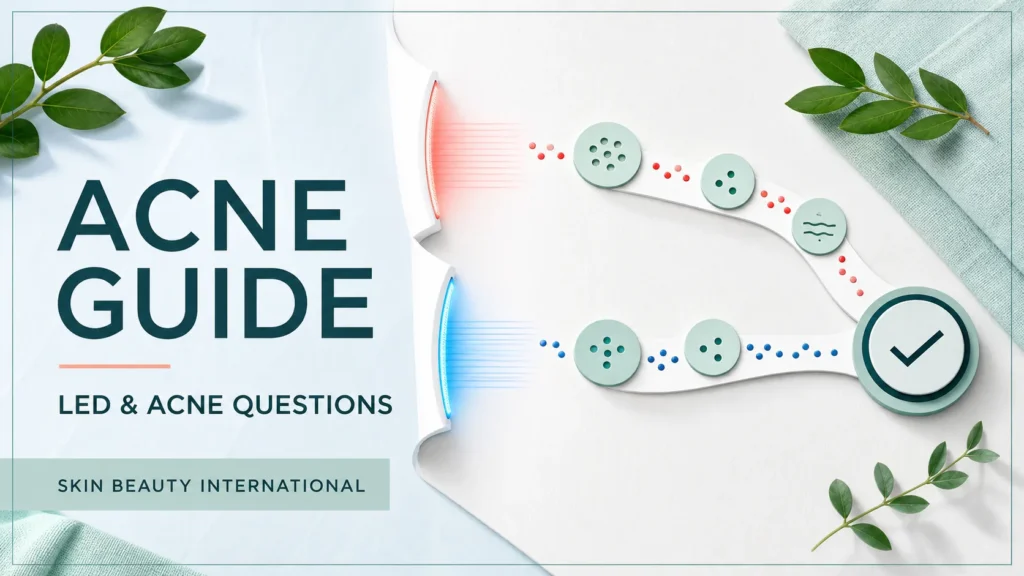
LED may be discussed as an adjunct for acne-prone skin, but it is not a diagnosis or guaranteed cure. Ask these five planning questions.
Direct answer
Treat LED as a question within an acne plan, not as a cure claim. Clarify whether the concern is active inflamed acne, flat post-acne colour or texture; list current treatment; ask which light and protocol are proposed; and decide how response and worsening symptoms will be reviewed.
For “LED for acne prone skin questions”, the decision starts with your own observations and the exact led therapy plan. Use the article to organise questions about LED therapy and acne-prone skin; it is not an instruction to proceed or a prediction of your result.
Start by separating active acne from what it leaves behind
Active lesions, post-inflammatory marks and scars are not interchangeable. Published light-based acne research addresses particular protocols and populations, so a general “LED clears acne” statement is too broad.
Moderate, severe, painful or scarring acne may need medical management. A beauty service can sit only within that boundary and should not encourage a client to abandon prescribed care.
What the evidence establishes
American Academy of Dermatology Association, American Academy of Dermatology Association, Photodermatology, Photoimmunology & Photomedicine / PubMed were selected to answer the evidence limits behind “LED for acne prone skin questions”. Their role is to support the specific history, safety and expectation questions below; none can assess the reader or approve the proposed service.
American Academy of Dermatology Association
Lasers and lights: How well do they treat acne?. Visible-light treatments may have a role for selected acne lesions. Light treatment does not address every type of acne lesion. In practice, the concern should be assessed before a treatment is chosen. Use this information to frame consultation questions rather than to decide suitability on your own.
American Academy of Dermatology Association
Acne: Diagnosis and treatment. Different types of acne can require different treatment. There is no one-size-fits-all acne plan. This supports a consultation-first approach and realistic expectations. Use this information to frame consultation questions rather than to decide suitability on your own.
Photodermatology, Photoimmunology & Photomedicine / PubMed
Comparison of red light and blue light therapies for mild-to-moderate acne vulgaris: A randomized controlled clinical study. Red and blue light have been compared in a small randomized study of mild-to-moderate acne. The study design and sample size limit universal predictions. The source helps define the boundary of the discussion; it does not establish individual suitability. Use this information to frame consultation questions rather than to decide suitability on your own.
These sources provide general context only. The provider should still explain how the proposed service, area and timing relate to your own consultation.
Four observations to bring
The four observations below narrow the LED therapy question without turning it into home diagnosis. Record only what you actually noticed, and leave any uncertain label open for assessment.
Lesion type
Describe blackheads, whiteheads, inflamed spots, deeper painful lesions, flat colour and texture separately.
Current treatment
List prescription and non-prescription products, side effects and recent changes.
Light plan
Ask which wavelength range, session plan and supporting evidence relate to the concern.
Progress measure
Use consistent photos and symptom notes rather than a filtered impression.
When preparing “LED for acne prone skin questions” notes, include dates, visible or sensory changes, relevant products or procedures and what happened next. Keep original photos unfiltered; another customer’s image cannot stand in for your acne-prone skin history.
Turn the observations into consultation questions
- Lesion type: “What limitation should I understand here?” Describe blackheads, whiteheads, inflamed spots, deeper painful lesions, flat colour and texture separately. Link the answer to keep skincare gentle: Avoid adding harsh scrubs or picking while trying to judge the response.
- Current treatment: “What would this observation change in the plan?” List prescription and non-prescription products, side effects and recent changes. Link the answer to coordinate medical care: Tell the relevant clinician about adjunctive beauty services when acne is under treatment.
- Light plan: “How will you assess this before proceeding?” Ask which wavelength range, session plan and supporting evidence relate to the concern. Link the answer to ask about eye protection: Confirm the protection and comfort process for every session.
- Progress measure: “Which part of the proposed service relates to this?” Use consistent photos and symptom notes rather than a filtered impression. Link the answer to set a stop rule: Know when lack of improvement, irritation or worsening acne should prompt reassessment.
Tie every answer back to the proposed led therapy, the area involved and the led therapy goal. If the explanation could apply to any customer, ask the team to make it specific before discussing a package.
A practical plan before booking
- Keep skincare gentle. Avoid adding harsh scrubs or picking while trying to judge the response.
- Coordinate medical care. Tell the relevant clinician about adjunctive beauty services when acne is under treatment.
- Ask about eye protection. Confirm the protection and comfort process for every session.
- Set a stop rule. Know when lack of improvement, irritation or worsening acne should prompt reassessment.
For acne-prone skin, document the start, timing and follow-up without adding an unrequested home experiment.
Fit the plan to Hong Kong life
For this Hong Kong led therapy enquiry, compare the proposed date with commuting heat, outdoor UV, work presentation, exercise and any fixed event. Tell the Causeway Bay team which part of that routine is least flexible so the preparation and review plan can be realistic.
For LED for acne prone skin questions, identify the one commitment that would be hardest to change. It may be outdoor work, a flight, a photographed event, daily exercise, contact-lens use or an active skincare schedule. Name it during the consultation and ask whether the proposed date still makes sense.
Current pricing is not listed in this guide because it should be confirmed before booking. Before travelling, ask Skin Beauty Int’l to confirm the current amount, inclusions, appointment length and whether the later acne-prone skin review is separate.
Know the boundary
Pause the LED for acne prone skin questions booking if the relevant area is actively painful, infected, broken, changing without explanation or outside a beauty provider’s scope. A promotion or diary deadline should not replace appropriate medical or eye-care assessment.
LED for Acne-Prone Skin: An Adjunct Question, Not a One-Treatment Promise does not establish suitability, settings, session count, healing, retention or downtime. Those outcomes vary, and the consultation must not convert a general source into a guarantee for one client.
Prepare the WhatsApp enquiry
For this led therapy enquiry, open WhatsApp with the treatment or concern, one relevant acne-prone skin detail, two possible date/time windows and a request for current price and preparation. Keep private records out of the chat.
The prepared Skin Beauty Int’l message for “LED for acne prone skin questions” is:
Hi Skin Beauty Int’l, I read your article “LED for Acne-Prone Skin: An Adjunct Question, Not a One-Treatment Promise”. I would like to ask about LED therapy. My main concern is ____. My preferred date is ____ and preferred time is ____. Please help me check suitability, current price and preparation.
The button uses +852 6473 3415. No unsupported GTM or GA4 event was added for this service. Continue with compare the treatment list and contact Skin Beauty Int’l.
For LED for acne prone skin questions, send an original photo only when it materially helps describe the concern. Do not attach identity documents, unrelated health files, edited comparisons or images belonging to someone else.
Sources
- Lasers and lights: How well do they treat acne? — American Academy of Dermatology Association
- Acne: Diagnosis and treatment — American Academy of Dermatology Association
- Comparison of red light and blue light therapies for mild-to-moderate acne vulgaris: A randomized controlled clinical study — Photodermatology, Photoimmunology & Photomedicine / PubMed
Sources were accessed on 30 July 2026.
Frequently asked questions
Can LED cure acne permanently?
No permanent-cure promise is supported. Acne varies, and light may be considered only as part of an individual plan.
Is LED for active acne or dark marks?
Different concerns need different assessment. Describe active lesions, flat marks and scars separately.
Can I keep using acne medication?
Tell the provider what you use and follow the prescribing clinician’s advice rather than changing treatment yourself.
How should progress be photographed?
Use the same light, angle, distance and camera settings without filters, and compare over an agreed interval.
Important note
This article provides general beauty information and does not diagnose a skin condition or replace medical advice. Results and suitability vary; consultation is recommended.
For a new, changing, painful, bleeding, infected or otherwise worrying concern related to led therapy, seek appropriate healthcare advice rather than delaying assessment for a cosmetic booking.